

Key Information
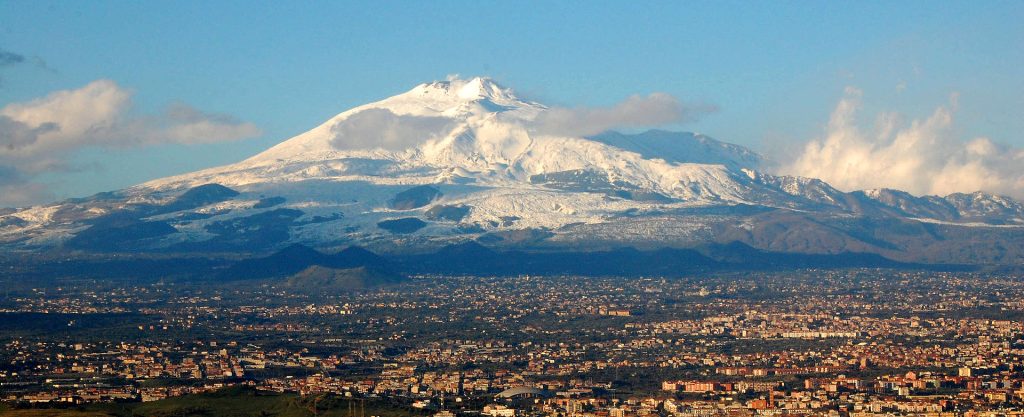
Mount Etna
| Type | Volcano (Statovolcano) |
| Height (Elevation) | 11,014 ft |
| Height (Prominence) | 11,014 ft |
| First Ascent (Climb) | Unknown |
| Last Eruption | May 29, 2022 (Small eruption) |
Learning Point
- Mount Etna has been an active volcano throughout human history, with eruptions happening regularly. A powerful volcano, it has progressively changed over its existence, and has also contributed to many different stories in Greek mythology.
Project
- Draw a picture of Mount Etna erupting.
- Overview
- Structure

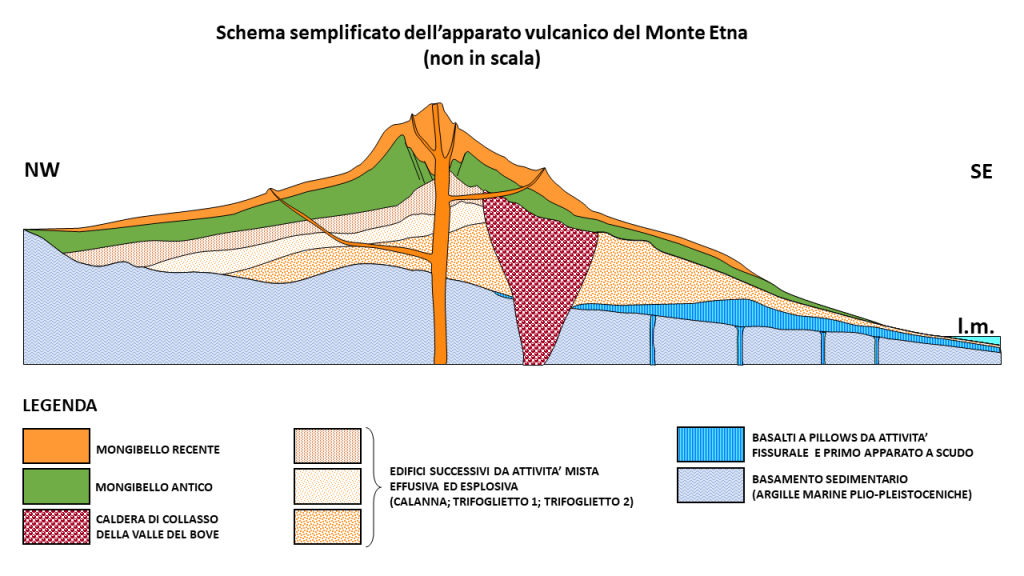

Simplified geological cross section of the Mt. Etna volcanic complex (not to scale), showing its evolution from an early stage of submarine fissural activity, producing pillow lavas and a first shield volcano, to a subsequent mixed effusive and explosive activity building three main stratovolcano stages (Monte Calanna; Trifoglietto 1; Trifoglietto 2), then to the present Mongibello system (which has developed in two successive stages from about 15,000 years ago). The volcanic activity has gradually shifted from SE to NW (from offshore to onshore). The Valle del Bove is a huge collapse of the eastern flank of the volcano, that occurred about 64,000 years ago, now allowing the older volcanic edifices to be recognized.
Location

| Located in | Sicily, Italy |
Fun Facts
- The name comes from the Greek Aitne, from aithō, “I burn.”
- It has been active for much of the last 2.6 million years according to some calculations.
- It has more than one centre of activity on it, including some along its sides.
- The most violent historical eruption, however, was in 1669 (March 11–July 15), when about 990 million cubic yards of lava were thrown out.
Past Lessons
| 81 | September 4, 2023 | (North America) |