

Key Information
Neptune
| Type | Planet |
| Diameter | 30,598 miles |
| Distance from the Sun | 2,796,170,365 miles |
| Orbit Time | 164.8 years |
| Length of Day | 16 hours 6 minutes |
| Temperature | -329 °F |
| Atmosphere | Thick and made from carbon dioxide, nitrogen and other elements |
| Date of Discovery | 23 September 1846 (Johann Galle, Urbain Le Verrier, John Couch Adams) |
| Moons | 16 |
Learning Point
- Neptune was the second planet discovered by astronmers, and is very similar in appearence to Uranus. It too has rings, and has been visited by Voyager 2. It also has one of the largest moons in the Solar System.
Project
- Draw a picture of Neptune.
- Overview
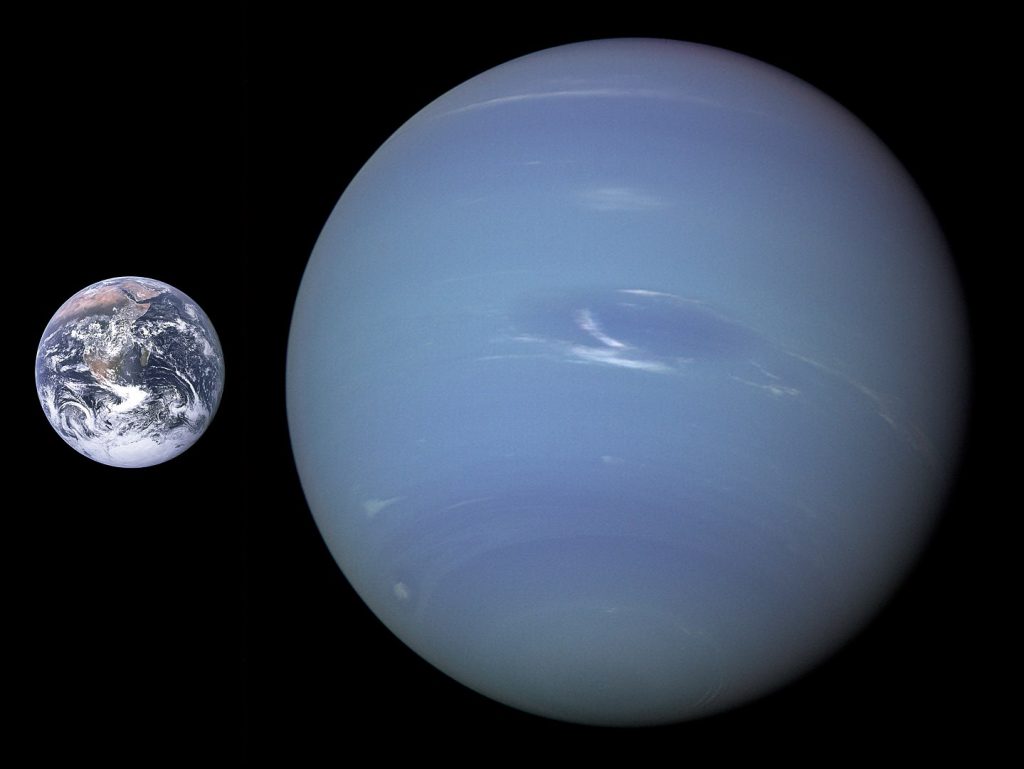
- Comparison

Media


Location

| Located in | Solar System, orbiting the Sun |
Fun Facts
- Neptune also has rings, like Uranus, but these also have small clustered arcs that appear in certain places of some of the rings.
- The moon Triton orbits Neptune, and is one of the largest in the Solar System.
- Neptune has a deeper blue color compared to Uranus, and also has more visible bands of clouds.
- Various storms have been seen around Neptune, including the Great Dark Spot first seen in 1989.
- At times the dwarf planet Pluto comes inside the orbit of Neptune, but in a way that it will never collide with it.
Past Lessons
| 14 | August 29, 2022 | (North America) |
| 103 | August 12, 2024 | (North America) |