

Key Information
Callisto
| Type | Moon (of Jupiter) |
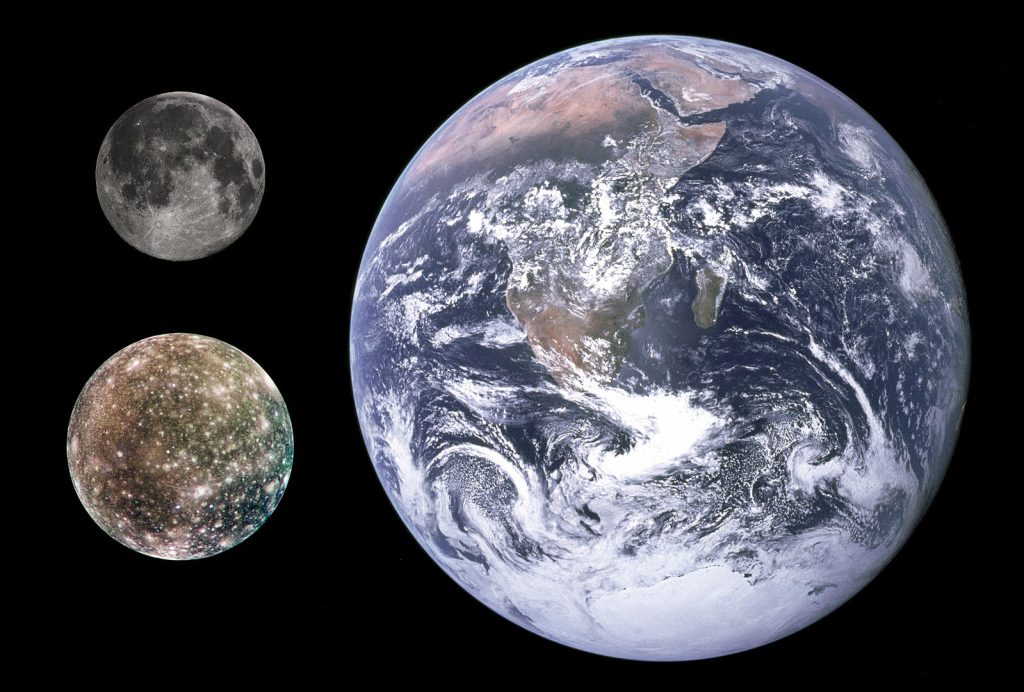
| Diameter | 2,995 miles |
| Distance from Jupiter | 1,117,000 miles |
| Orbit Time | 16.689 Earth days |
| Length of Day | 16.689 Earth days |
| Time around Sun | 11.863 Earth years |
| Atmosphere | Thin, Carbon Dioxide |
| Temperature | -160 °F |
| Date of Discovery | January 7, 1610 (Galileo Galilei) |
Learning Point
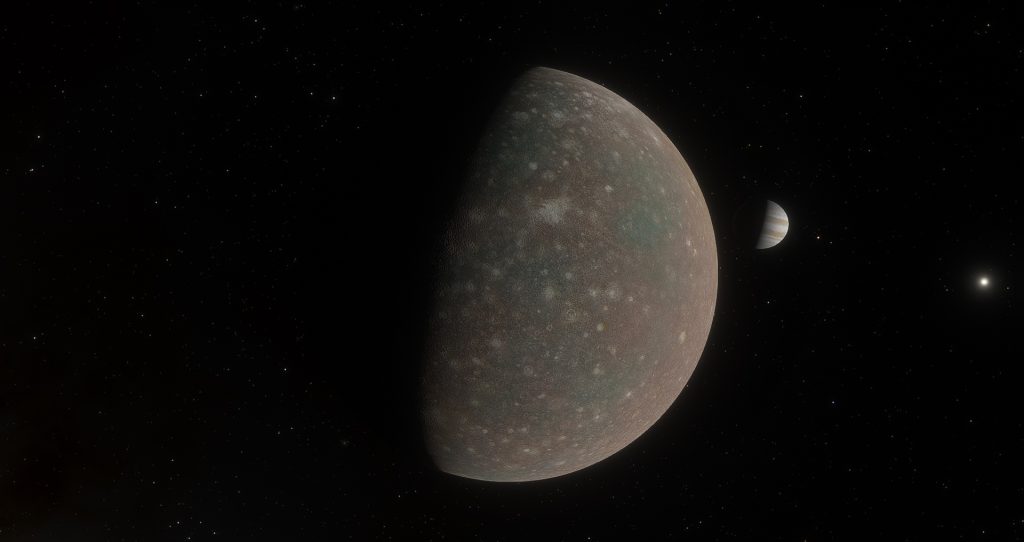
- The surface of Callisto is one of the most heavily cratered in the Solar System and is ancient in that it hasn’t changed a lot over a long time. There are many instances of chains or rows of craters related to the same impact.
Project
- Draw Callisto showing the craters and shapes we see on the surface.
- Overview
- Comparison

Fun Facts
- Two of the largest features on Callisto are Asgard and Valhalla, massive craters with rings around them because of the impact from the rock that hit the moon.
- Valhalla is a crater more than 370 miles across, with rings extending out to over 1,100 miles.
- Catanae are long chains of impact craters that are lined up on the surface. It’s possible these are caused by asteroids and comets that have broken up while passing by Jupiter and landed in a long line.
- The four largest moons of Jupiter – Ganymede, Io, Callisto and Callisto – are called the Galilean moons after Galileo Galilei which were all discovered on January 7, 1610.
Past Lessons
| 30 | May 3, 2022 | (North America) |
| 95 | February 16, 2023 | (International) |
| 223 | May 6, 2025 | (North America) |