

Key Information
55 Cancri
| Type | Star System (binary) |
| Star Types | KOIV-V – Orange dwarf (A), M4.5V – Red dwarf (B) |
| Diameter | 815,295 miles (A), 231,706 miles (B) |
| Mass | 0.905 M☉ (A), 0.264 M☉ (B) |
| Temperature | 8,850 °F (A), 5,510 °F (B) |
| Distance | 40.95 light years |
| Date of Discovery | Unknown |
| Other Names | Copernicus, HD 75732, HR 3522 |
Learning Point
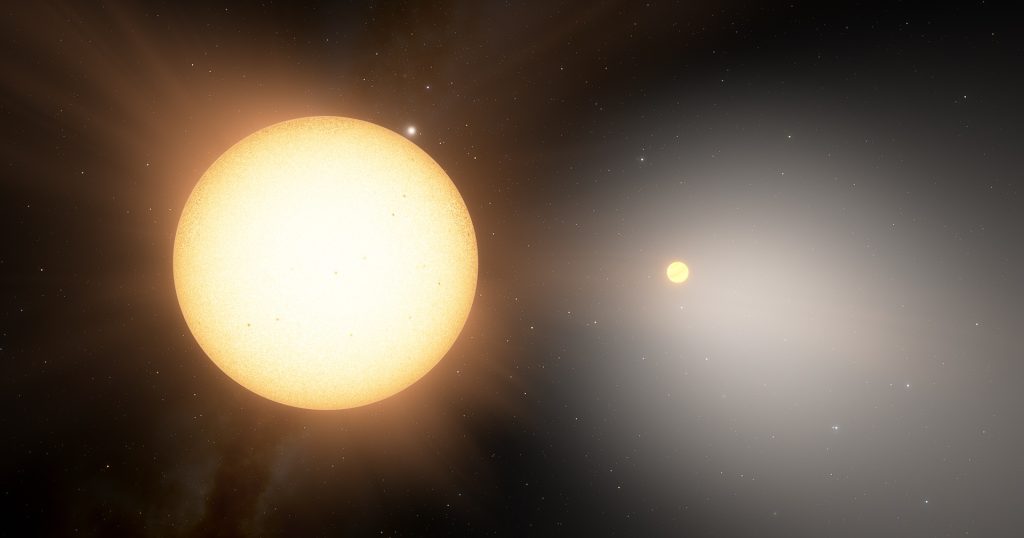
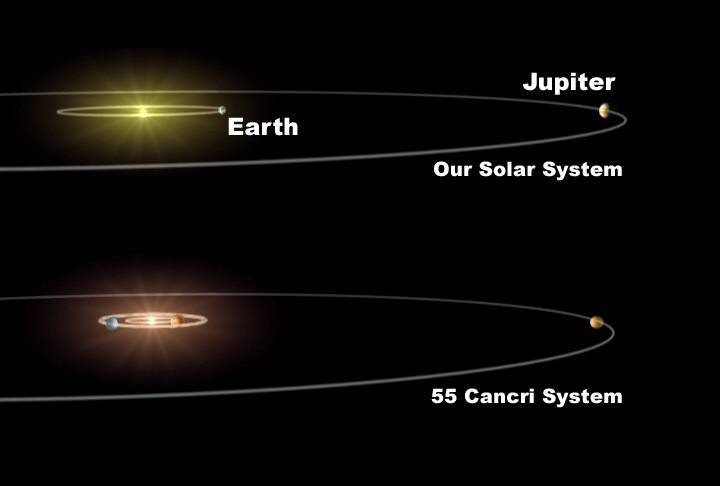
- 55 Cancri is a close binary star system that has been discovered to have at least five planets. The main star’s similar size to our Sun and the interesting positions of some of the planets have led to comparisons with our own Solar System, but more recent discoveries have shown its planets are very different.
Project
- Identify what might be missing from this star system.
- Overview
- Comparison
Location
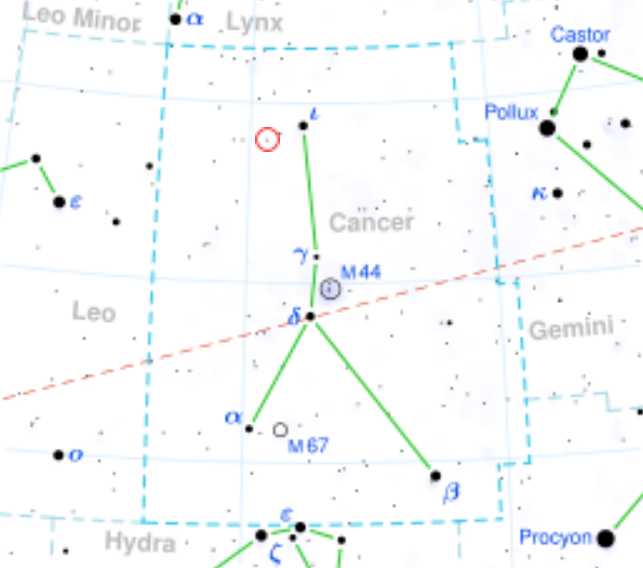

| Located in | Cancer constellaion, within the Milky Way |
Fun Facts
- The name given to the main star is Copernicus, and the five planets are named Galileo, Brahe, Lipperhey, Janssen and Harriot.
- Copernicus is classified as a super metal-rich star (SMR) because it has almost double the amount of iron that our Sun has.
- 55 Cancri e (Janssen) is a super-earth orbiting in about 18 hours.
- Recent observations by the James Webb Space Telescope suggest it has an atmosphere, made mostly from carbon dioxide or carbon monoxide.
Past Lessons
| 95 | June 17, 2024 | (North America) |
| 171 | April 7, 2026 | (North America) |